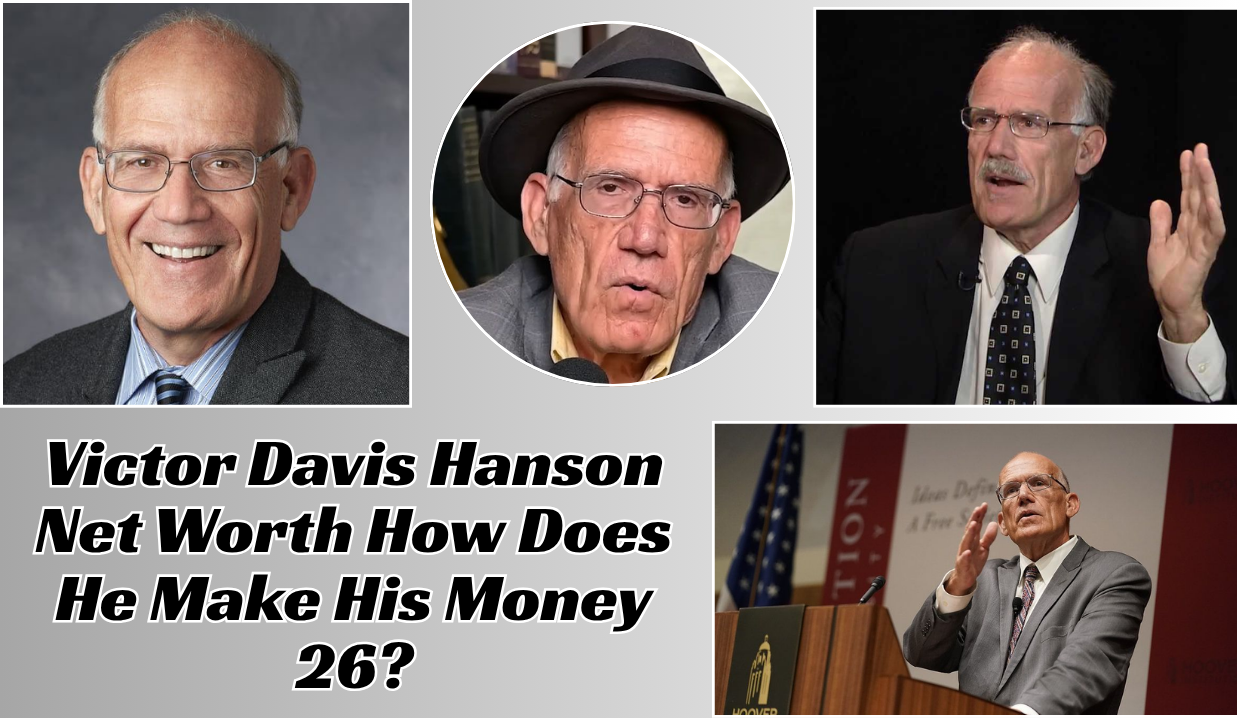
When people search for “Victor Davis Hanson net worth,” they are usually looking for a simple number. But for public intellectuals, the reality is more layered. Wealth doesn’t come from a single salary or one job. It is built over decades through books, academic roles, media presence, speaking engagements, and long-term assets.
Victor Davis Hanson is a historian, writer, and commentator whose career spans academia, publishing, and public media. Because of this multi-stream career, estimating his net worth requires looking at each income source separately.
Instead of a fixed figure, what matters more is how his wealth is structured and how it has grown over time.
Who Is Victor Davis Hanson?
Victor Davis Hanson is an American historian known for his work on ancient warfare, Western civilization, and modern political analysis. He has written extensively on historical military strategy and contemporary political trends.
He has worked in academic institutions and research organizations, contributing both scholarly work and public commentary. Over time, he became widely recognized in media circles, expanding his influence beyond academia.
His career can be broadly divided into three phases:
- Academic historian and professor
- Published author of historical and political books
- Media commentator and public intellectual
Each phase added a different income stream, shaping his financial profile.
Victor Davis Hanson Net Worth Overview
There is no officially verified public figure for his total net worth. However, financial estimates are typically derived from known income categories:
- Long-term academic earnings
- Book royalties over decades
- Media contributions and commentary work
- Speaking engagements
- Agricultural and property-related income
Instead of a fixed number, his wealth is best understood as a multi-source accumulation model, where each stream compounds over time.
Key insight:
His financial profile is not based on sudden wealth but long-term intellectual productivity.
Victor Davis Hanson Income Sources Explained
Academic Salary and Fellowships
A significant portion of his early and mid-career income came from academia. Professors in established institutions typically earn stable salaries with incremental growth based on tenure, publications, and teaching experience.
In addition to base salary, roles such as fellowships and research positions at think tanks contribute additional income.
For example, affiliations with research institutions like the Hoover Institution often include compensation for research work, publications, and advisory roles.
Academic income alone is usually modest compared to media earnings, but it provides long-term stability and credibility.
Also read: Don Toliver Net Worth How Much Is He Really Worth Today
Book Royalties and Publishing Income
One of the strongest contributors to his wealth is book publishing.
Authors in this category typically earn through:
- Advance payments from publishers
- Royalties per book sale
- Foreign rights licensing
- Long-tail sales over decades
Books on history, politics, and culture often have extended lifespans. Unlike trending content, they continue generating income for years.
Over time, a successful catalog of books can become a stable passive income source.
Media Appearances and Commentary
As his public profile grew, media contributions became another revenue stream. Political analysts and historians often earn fees for:
- Television commentary
- Online media appearances
- Guest columns
- Interviews and panel discussions
This category varies widely in income depending on frequency and platform reach.
Media exposure also indirectly increases book sales and speaking opportunities, making it both a financial and branding asset.
Speaking Engagements and Keynote Fees
Public speaking is one of the most profitable income streams for well-known intellectuals.
Typical speaking engagements may include:
- University lectures
- Political forums
- Think tank conferences
- Private organizational events
Fees depend on reputation, topic demand, and audience size. Established commentators often command premium rates per event.
This income stream is highly flexible and scales with popularity.
Think Tank and Institutional Earnings
Institutions like policy research organizations often provide:
- Salaries or stipends
- Research funding
- Publication support
- Event participation fees
These roles are not just financial but also strategic, as they strengthen credibility and public authority.
Such institutional affiliations play a long-term role in both income and influence.
Agricultural and Land-Based Income
A less discussed but important part of his financial profile is agricultural involvement.
In many cases, intellectuals with rural ties or property holdings may earn income from:
- Farming operations
- Land leasing
- Agricultural production
This type of income is usually stable and tied to asset appreciation over time rather than short-term earnings.
Assets and Investments
Real Estate Holdings
Real estate is often one of the most important wealth-building components for long-term professionals.
Property value appreciation contributes significantly to net worth over decades. Residential and rural properties may also generate rental or operational income.
Farmland and Agricultural Assets
Land ownership, especially agricultural land, tends to increase in value gradually. It also provides:
- Operational revenue
- Tax advantages
- Long-term capital appreciation
This aligns with the broader rural economic model found in parts of California’s Central Valley.
Investment Portfolio Insights
While private investment details are not publicly available, individuals in similar positions often diversify into:
- Mutual funds
- Retirement accounts
- Conservative equity investments
The goal is usually wealth preservation rather than aggressive speculation.
Career Evolution and Wealth Growth
Academic Foundation
His early career focused on teaching and research. While not highly lucrative, this stage built intellectual authority.
Expansion into Publishing
Book writing transformed his income potential significantly. A strong publishing record creates long-term royalty streams.
Media Transition
Media exposure multiplied his visibility, indirectly increasing all other income sources.
Public Intellectual Branding
Over time, his name became a brand associated with historical and political analysis. This branding effect is a major driver of long-term financial stability.
Comparative Wealth Analysis
When comparing historians and commentators, income differences often depend on:
- Media exposure level
- Number of published books
- Speaking demand
- Institutional affiliations
Academic historians typically earn less than media commentators, but those who bridge both worlds tend to build stronger financial outcomes.
This creates a hybrid model:
- Academic credibility
- Media monetization
- Publishing royalties
Financial Influence of His Books
Books remain a core part of his financial ecosystem.
Long-Term Royalty Structure
Unlike salaried income, book royalties can continue for decades. Even older publications may still generate steady revenue.
Compounding Effect
Each new book increases visibility for older titles, creating a compounding income loop.
Intellectual Property Value
Books function as long-term intellectual assets, similar to digital property that generates recurring returns.
Key Takeaways: How His Wealth Model Works
Instead of relying on one profession, his financial structure is built across multiple domains:
- Stable academic foundation
- Publishing and royalties
- Media visibility and commentary
- Speaking engagements
- Institutional affiliations
- Property and land assets
This diversified model reduces financial risk and increases long-term stability.
Conclusion: A Multi-Layered Wealth Profile, Not a Single Number
The search for a precise “Victor Davis Hanson net worth” number oversimplifies a complex financial reality. His wealth is not built on one income source but on decades of layered professional work.
The real insight is not the number itself, but the structure behind it:
a combination of academic authority, publishing success, media relevance, and long-term asset accumulation.
This type of financial model is common among established public intellectuals who have successfully expanded beyond traditional academic roles into broader cultural and media influence.
Understanding this structure provides a clearer picture than any estimated figure ever could.
